Reddit Sentiment Analysis: A Practical Scraper Workflow
 Sam Wilson
Table of Contents▼
- Why perform sentiment analysis on Reddit?
- What Reddit data should you collect before scoring sentiment?
- How do you collect sentiment data with Upvote.net?
- How do you clean Reddit text before sentiment scoring?
- Which sentiment analysis approach should you use?
- How do you validate and interpret Reddit sentiment scores?
- How should you report Reddit sentiment results?
Reddit sentiment analysis works when you treat sentiment as a labeled measurement of collected conversations, not a direct reading of public opinion. Use Upvote.net's Reddit Scraper to collect comparable posts and comments, preserve timestamps and context, score the text with a model, review a sample, and aggregate results by time, subreddit, or keyword.
The scraper collects the records. Your analysis pipeline defines the match, handles duplicates, scores the text, and sets the point for human review.
Key takeaways
- Define the Reddit scope, keyword set, time window, and fields before collecting.
- Use Upvote.net URL or search targets to build repeatable JSON or CSV snapshots.
- Clean quoted text, deleted content, duplicates, and bot-like noise before scoring.
- Treat sentiment labels as model outputs that need validation, especially for sarcasm and community slang.
- Report counts, uncertainty, and sample limits beside every sentiment percentage.
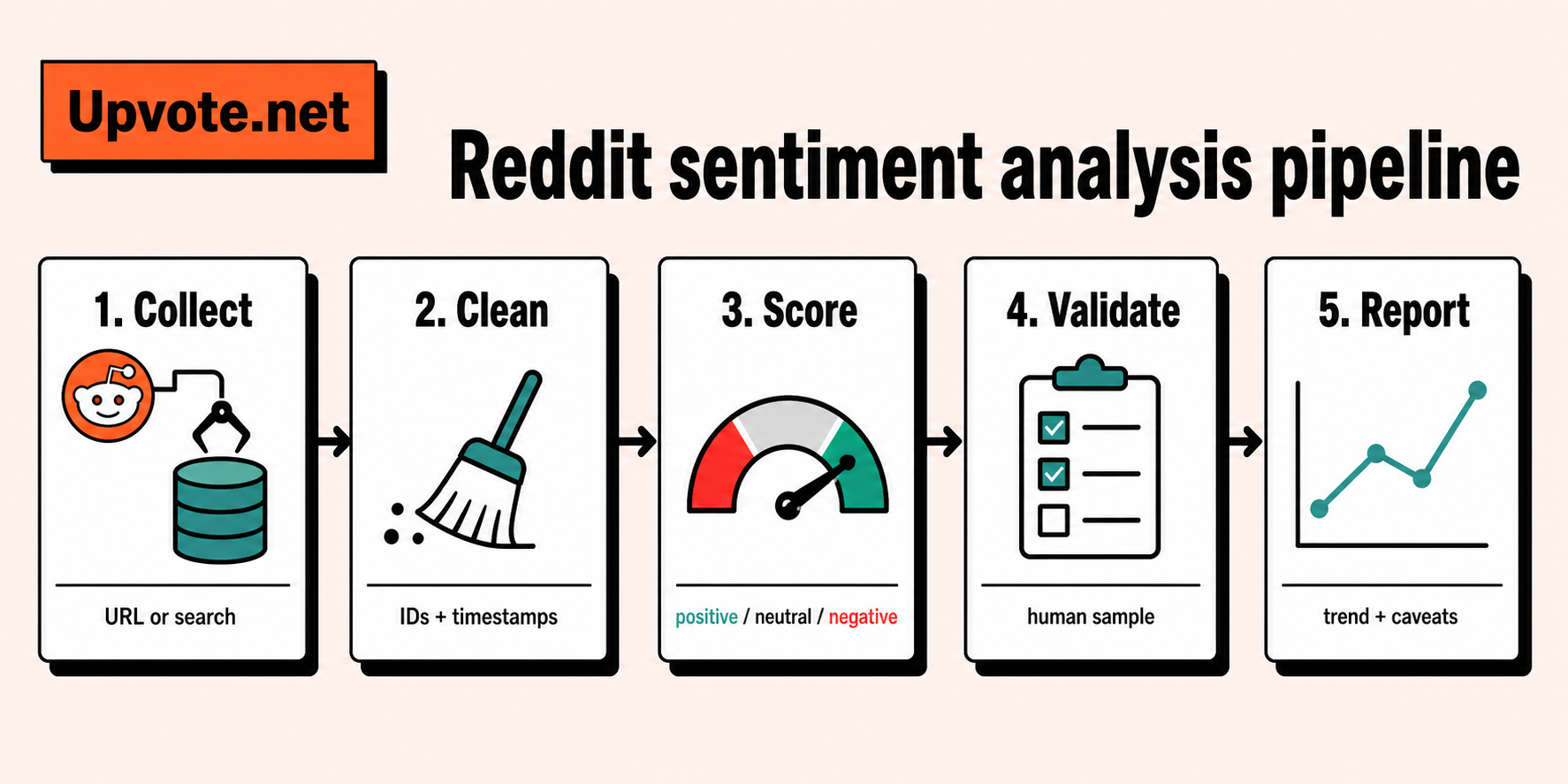
Reddit sentiment analysis is the process of assigning sentiment labels or scores to Reddit posts and comments, then comparing those results across a defined sample. It can reveal how a conversation is changing, but it cannot prove what every Reddit user or the wider market believes.
Why perform sentiment analysis on Reddit?
Reddit sentiment analysis is useful when you need language-rich feedback tied to specific communities, products, events, or questions.
Posts provide the initial claim; comments add agreement, objections, corrections, and context.
A careful workflow can turn those conversations into signals for research, support, content planning, and brand monitoring.
Reddit's Public Content Policy explains that public posts, comments, usernames, profiles, and related metadata can be visible without an account. Public visibility does not make the data representative, context-free, or unrestricted for every downstream use.
Ask a narrow question: How did sentiment around one product or topic change inside a defined Reddit sample? That is easier to test than “What does Reddit think?”
Use case | Useful signal | Limitation to record |
|---|---|---|
Brand monitoring | Sentiment by keyword, subreddit, and week | The sample misses conversations your query did not collect |
Product research | Repeated complaints, requests, and praise | Loud or highly active users can dominate the sample |
Launch review | Sentiment before and after an announcement | A news event can change the mix of commenters |
Competitor research | Same rubric applied to several products | Product names may be mentioned in different contexts |
Support triage | Negative comments with issue phrases | Sarcasm, quotes, and missing context can fool a model |
Pair this workflow with the Reddit SEO strategy guide when you need broader search and community context. Sentiment is one layer in an analysis, not a replacement for reading the source threads.
What Reddit data should you collect before scoring sentiment?
Collect the text and metadata that explain each sentiment score: stable record ID, post or comment type, title, body, subreddit, creation time, parent relationship when available, source target, collection time, and the keyword or rule that matched it. Do not collect author or profile fields unless the research question and policy review require them.
Start with a written scope:
- Keywords: exact terms, variants, product names, misspellings, and community slang.
- Communities: a fixed subreddit list, a search scope, or both.
- Time rule: creation time for the trend bucket and collection time for freshness.
- Record types: posts, comments, communities, or users.
- Sentiment unit: one label per post, one label per comment, or sentence-level labels.
- Exclusions: deleted text, quoted passages, bot messages, duplicate IDs, and off-topic matches.
Keep created_at and collected_at separate. A comment collected today may describe an event from last month, and assigning it to the download date can create a false spike.
Field | Why it matters for sentiment analysis |
|---|---|
| Deduplicates overlapping search results and URL windows |
| Separates posts, comments, communities, and users |
| Preserve the text the model and reviewer will inspect |
| Lets you compare community-specific language |
| Places the record in the correct time bucket |
| Restores reply context when a comment is ambiguous |
| Shows which keyword or rule selected the record |
| Reproduces the collection event |
Do not collapse all text into one field before you save the raw export. Keep the original title, body, and metadata intact, then create a normalized analysis table.
How do you collect sentiment data with Upvote.net?
Use Upvote.net's Reddit Scraper to queue URL or search targets, choose JSON or CSV output, and save the run metadata beside the result. As of September 2026, the API documentation lists up to 50 URLs per request, a default limit of 20 items per target, listings and comments up to 1,000 when Advanced entities are not selected, concurrency from 1 to 20, and entity groups for posts, comments, communities, and users.
If you first need to find and triage brand or competitor conversations, Upvote.Net Lead Finder uses Mentions, Leads, and one-query Search for human review. Keep the Scraper and your analysis pipeline for collection, sentiment scoring, validation, and reporting; Lead Finder does not score sentiment for you.
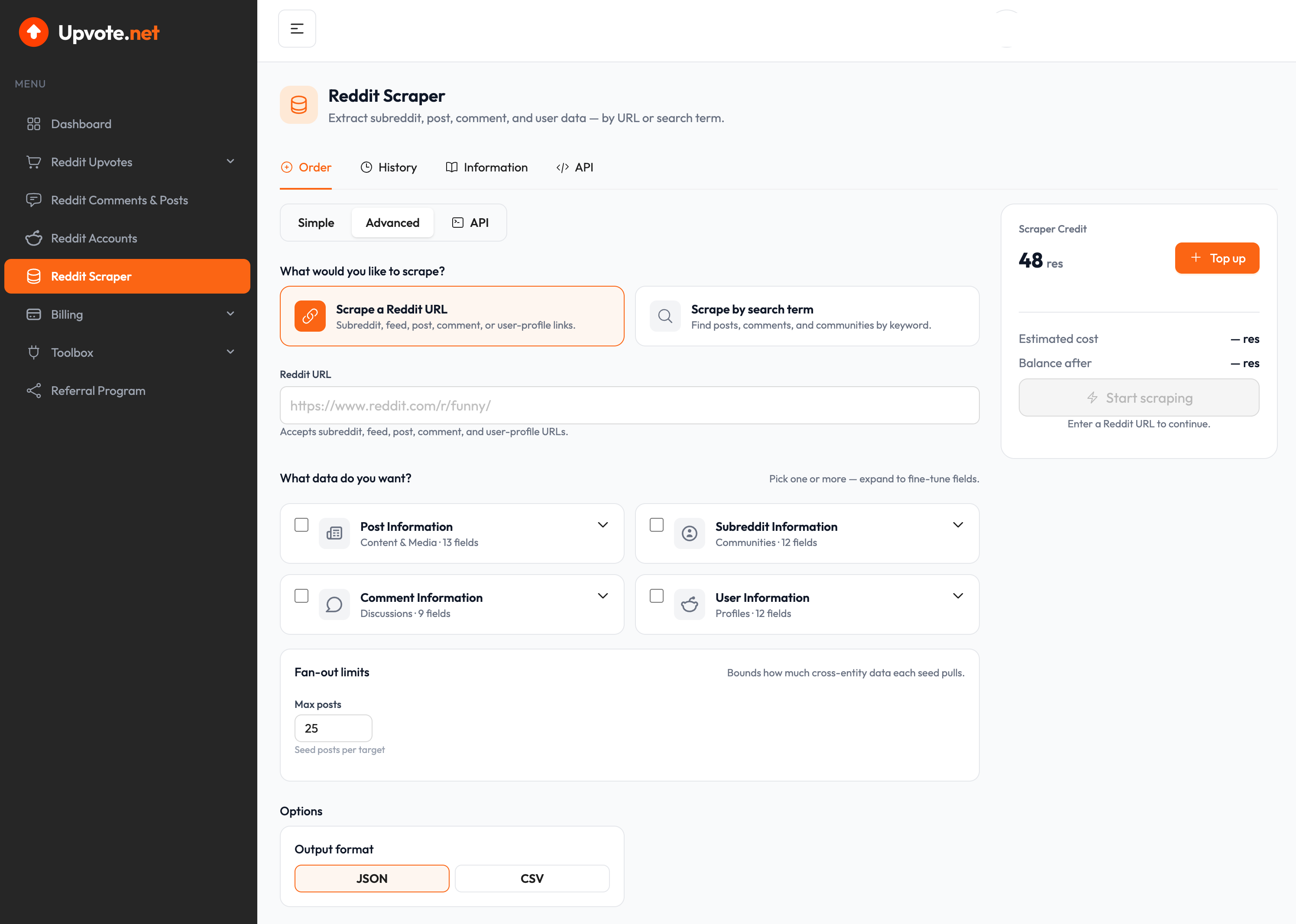
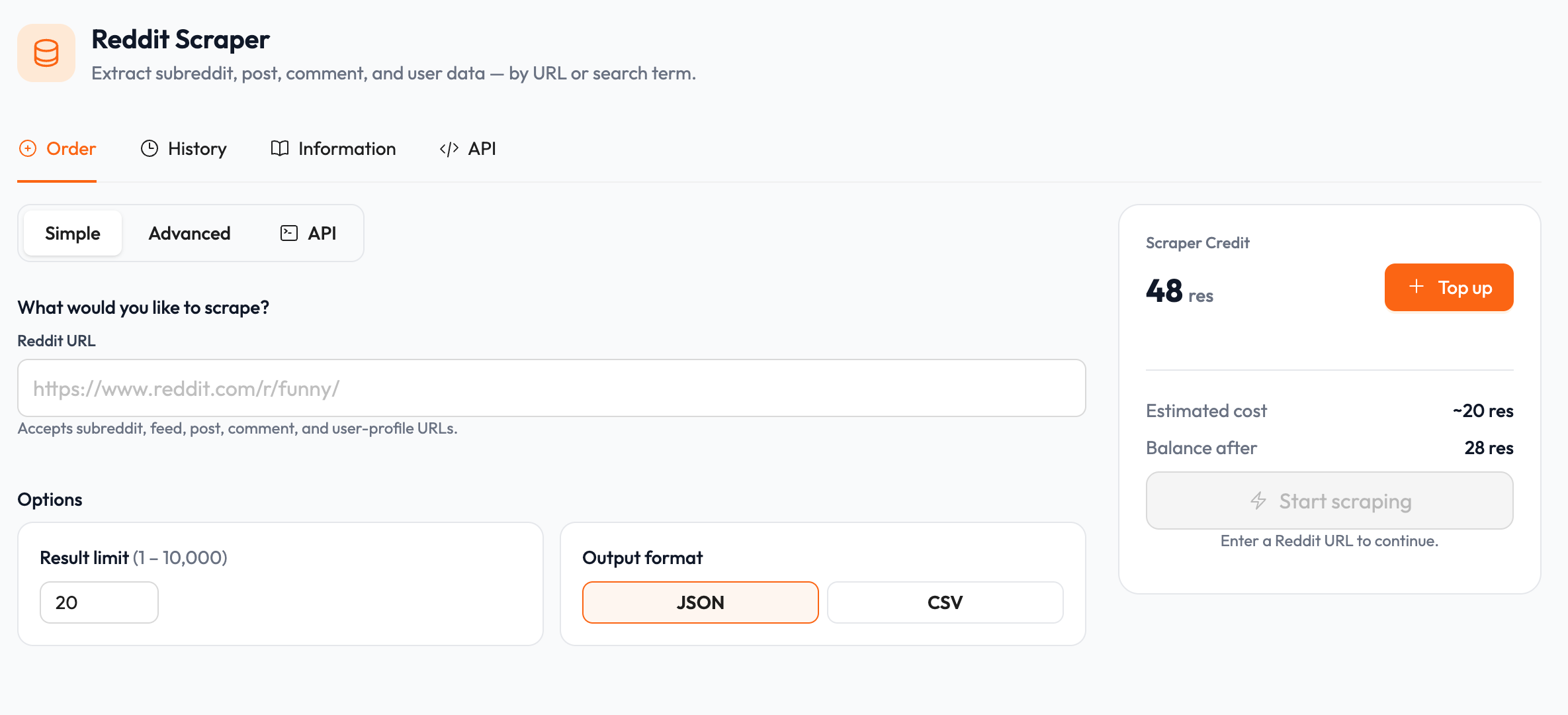
In-app proof: Advanced mode exposes entity groups and fan-out controls; Simple mode keeps a URL snapshot focused on a result limit, credit estimate, and output format.
The Reddit Scraper API documentation says one successful result costs one Scraper Credit, failed or errored results cost nothing, and queued runs expose reserved credit before final charged_credits are reported. Use those fields to reconcile each collection run rather than estimating cost from the number of URLs alone.
Build the collection loop in five steps:
- Write the manifest. Save keywords, URLs, fields, limits, sort, time rule, output format, and UTC collection time.
- Submit the run. Send a
POSTrequest to/v1/scraperwith your API key. - Poll the status. Check
/v1/scraper/{runId}until the run iscompletedorpartial. - Download the result. Call
/v1/scraper/{runId}/downloadand move the file into storage you control. - Repeat outside the scraper. Use cron, GitHub Actions, a workflow runner, or your own worker for a fixed cadence.
curl https://api.upvote.net/v1/scraper \
  --request POST \
  --header 'Content-Type: application/json' \
  --header 'X-API-Key: YOUR_SECRET_TOKEN' \
  --data '{
    "urls": ["https://www.reddit.com/search/?q=upvote.net"],
    "limit": 100,
    "sort": "new",
    "format": "json"
  }'
The API handles collection and run state. Your worker handles recurring schedules, keyword versioning, sentiment scoring, and reporting.
How do you clean Reddit text before sentiment scoring?
Clean Reddit text conservatively.
Remove only the artifacts that would distort the question you are asking, and keep the raw export for audit.
Normalize whitespace, preserve punctuation that carries emotion, deduplicate by stable ID, and mark deleted or unavailable text instead of silently treating it as neutral.
Use this cleaning sequence:
- Normalize encoding and whitespace. Keep emojis, capitalization, exclamation marks, and question marks because social-text models use them as signals.
- Separate quoted text. A reply that says “that product is terrible” may be quoting someone else rather than expressing the author's view.
- Remove duplicate records. Count a record once even when multiple search targets return it.
- Mark context. Keep subreddit, parent thread, score, reply count, and creation time beside the cleaned text.
- Filter clear noise. Exclude bot notices, link-only records, empty bodies, and records outside the scope.
- Version the rules. Store a
cleaning_versionandkeyword_set_versionso a later run can explain why counts changed.
Do not remove all URLs, usernames, or slang automatically.
A product URL, subreddit name, or community phrase can be the very signal you need.
Use a separate text_for_model field and keep the original fields unchanged.
Which sentiment analysis approach should you use?
Choose the simplest model that matches your language, volume, and review budget. VADER is a useful first pass for short social text; transformer classifiers can capture richer context but require careful model selection and validation; human labels remain necessary for measuring whether the automated output is trustworthy for your subreddit and topic.
Approach | Best starting point | Main trade-off |
|---|---|---|
VADER | Short posts, comments, emojis, and fast baselines | Misses domain-specific sarcasm and nuanced context |
Fine-tuned transformer | Stable labeled data and a specialized domain | Requires more compute, labels, and monitoring |
LLM classification | Small, high-value samples that need explanations | Cost, consistency, privacy, and reproducibility need controls |
Human review | Gold labels, edge cases, and policy-sensitive topics | Slow and expensive at large scale |
The VADER paper describes a rule-based model designed for social-media language.
The VADER implementation provides a Python implementation and common starting thresholds for the compound score: values at or above 0.05 are positive, values between -0.05 and 0.05 are neutral, and values at or below -0.05 are negative.
Treat those thresholds as a baseline, not a universal truth.
Example VADER scoring code:
from vaderSentiment.vaderSentiment import SentimentIntensityAnalyzer

analyzer = SentimentIntensityAnalyzer()

def classify(text):
    compound = analyzer.polarity_scores(text)["compound"]
    if compound >= 0.05:
        label = "positive"
    elif compound <= -0.05:
        label = "negative"
    else:
        label = "neutral"
    return {"label": label, "compound": compound}
Run the model on one record at a time, save the raw score and label, and keep the model name, version, threshold rule, and run ID in the output table.
How do you validate and interpret Reddit sentiment scores?
Validate sentiment scores with a human-reviewed sample before using them for decisions.
Stratify the sample by subreddit, label, time period, and text length so you can see where the model fails.
Review sarcasm, negation, quoted language, mixed opinions, jokes, domain slang, and comments that depend on the parent post.
Create a small gold set with three labels: positive, neutral, and negative.
Add an “unclear” note when a reviewer cannot label the text without more context.
Then compare the model label with the human label and inspect the errors instead of reporting accuracy alone.
Failure pattern | What the model may do | Review question |
|---|---|---|
Sarcasm | Score praise as positive | Is the surrounding thread mocking the product? |
Negation | Miss “not bad” or “never works” | Does the modifier reverse the meaning? |
Quoted text | Score another user's words | Who is actually making the claim? |
Mixed sentiment | Force one label on praise plus a complaint | Should the record receive sentence-level labels? |
Community slang | Treat an in-group phrase as ordinary language | What does the phrase mean in this subreddit? |
Missing context | Score a short reply incorrectly | Does the parent post change the interpretation? |
Aggregate only after you know what each row means. Useful metrics include:
- Sentiment share: records in one label divided by all scored records in the same scope.
- Net sentiment: positive share minus negative share, with neutral records shown separately.
- Volume by label: positive, neutral, and negative counts per day or week.
- Community mix: the same metrics broken out by subreddit.
- Issue phrase frequency: recurring terms inside negative or unclear records.
Keep raw counts beside percentages. A small sample can produce a dramatic percentage swing without representing a meaningful change in the conversation.
How should you report Reddit sentiment results?
Report sentiment as a scoped measurement with a clear denominator, collection window, model rule, and review note. A useful report shows label counts over time, the communities that contributed those records, representative examples, and the collection or modeling changes that could explain a spike.
Use a simple report layout:
- Scope card. Keywords, subreddits, record types, date rule, and run IDs.
- Trend view. Positive, neutral, and negative counts by week, with raw counts visible.
- Community view. Sentiment share and volume by subreddit.
- Evidence table. Reviewed examples with links, labels, and context notes.
- Limitations box. Sampling gaps, model errors, deleted content, and any rule changes.
If you need broader time-series views, connect the sentiment table to the Reddit keyword trends workflow. The collection layer should remain separate from the interpretation layer so you can rerun the model without scraping the same scope again.
Reddit's Data API Terms restrict certain uses of User Content, including training a machine-learning or AI model without express permission from applicable rights holders.
Reddit also explains that public content does not include private messages, private communities, or deleted posts and comments in its Public Content Policy. Its data deletion guidance says downstream users must stop displaying or using content after it is deleted.
Collect the minimum fields needed for the sentiment question, avoid author profiling, keep a removal process, and review current Reddit policies before scaling. Sentiment analysis can prioritize research and support work; it cannot replace reading the threads that produced the score.
Open the Upvote.net Reddit Scraper API docs to build the collection layer, then validate your first labeled sample before you automate a dashboard or alert.

Hey, I'm Sam. I've spent the last 8 years figuring out what actually works on Reddit (and what gets you instantly banned). After growing several brands through organic Reddit presence, I started Upvote to help others do the same - without the trial and error. When I'm not diving into subreddit analytics, you'll find me reading about consumer psychology or debating the best coffee brewing methods.
Related Articles




Want to amplify your Reddit results?
Explore Our Reddit Upvote Services