How to Measure AI Search Visibility for Your Brand
 Sam Wilson
Table of Contents▼
AI search visibility is the extent to which an AI answer includes your brand, describes it accurately, or links to your site when someone asks a relevant question. A scan gives you a dated sample of that visibility so you can see the prompts, competitors, and source pages shaping discovery.
Upvote.Net AI Search turns that check into a $5 per scan workflow for identifying brand visibility, relevant sources, and the buyer questions and competitor comparisons behind those answers.
Key takeaways
- A brand mention, a source citation, and a position inside an answer are different signals.
- AI Search connects those signals to the prompts, competitors, and cited websites behind a scan.
- The current product UI shows ChatGPT, Gemini, and Perplexity filters.
- Use the scan as a dated baseline for deciding what to investigate next.
What is AI search visibility?
AI search visibility describes how your brand appears when an AI system answers a category, comparison, alternative, or problem-based question.
A mention shows that the answer names your brand or product. A citation shows that the answer links to a source you can inspect.
Answer position describes where your brand appears within that answer. It is a different measure from your position in Google search results.
These signals overlap, but they do not mean the same thing. OpenAI’s search guidance says ChatGPT search can show inline citations and a Sources panel.
Google’s AI features guidance says AI Overviews and AI Mode surface links from its Search systems, and that inclusion is never guaranteed.
Signal | What you observe | What it helps you interpret | What it does not prove |
|---|---|---|---|
Mention | The answer names your brand or product. | Whether the system connects your brand to the tested topic. | That the description is positive, accurate, or backed by your site. |
Citation | The answer links to your domain or another source. | Which pages and websites support the measured answer. | That the cited page ranks first in Google, sends traffic, or endorses your brand. |
Answer position | Your brand or a competitor appears earlier or more prominently in one answer. | Relative visibility inside that prompt and scan. | A stable ranking, a universal share of voice, or a sales outcome. |
Competitor presence | Other brands appear for the same prompt. | Which alternatives the audience may see while researching. | That those brands win the customer or that your brand cannot compete. |
An answer can mention a brand without citing it. A page can be cited without driving a visit.
A high position in one answer can change when the prompt, index, location, model, or date changes.
What does Upvote.Net AI Search measure?
Upvote.Net AI Search organizes a brand visibility check around four questions: what prompts bring your brand into the conversation, which competitors appear beside it, which websites get cited, and where the evidence leaves a gap. The Overview summarizes the scan in cards and points you toward the next views to inspect.
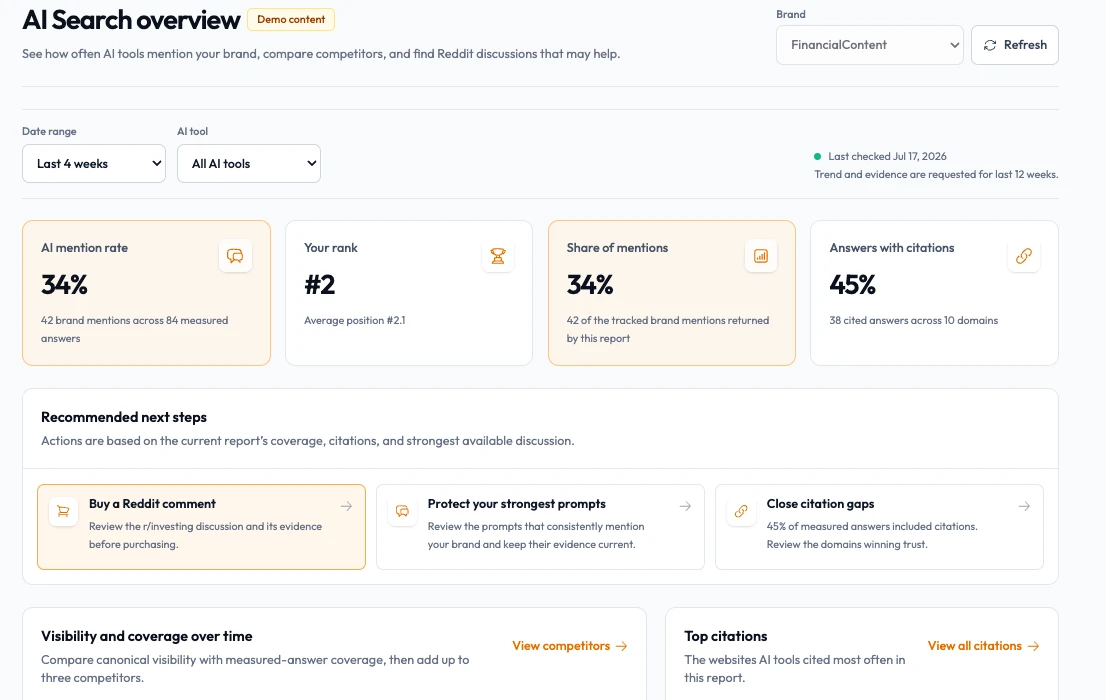
Demo data: AI Search overview cards and next-step guidance.
The current demo flow includes these areas:
- Overview: Start with the summary cards and next-step guidance for the scan.
- Prompts: Enter, review, and approve the questions you want to use. This view shapes the query set; it does not replace the measured results.
- Citations: Inspect the domains and pages that support the measured answers. This is the source-discovery layer.
- Competitors: Compare the brands returned for the same question set so you can see the category context around your own result.
The main limitation is scope: a scan reflects the selected prompts and platforms at one point in time.
The current UI shows filters for ChatGPT, Gemini, and Perplexity. Record the selected platforms, prompt set, and scan date so you can compare the same scope later.
Open a tracked prompt to review the measured answer and its cited pages. If a competitor appears, check how the answer describes it and whether that description matches the buyer’s question.
If another website is cited repeatedly, you can review the page and ask whether your own content or third-party context answers the same buyer question.
How do you run an AI Search scan?
Run an AI Search scan through a four-step setup: describe the website, add competitor URLs, review or add prompts, then confirm the initial measurement. After the scan completes, use Overview, Prompts, Citations, and Competitors to interpret the result.
As of September 16, 2026, the launch price is $5 per scan.
- Describe the website. Open the Upvote.Net dashboard and choose AI Search. Enter the website, add an optional description, and check the brand preview so the scan starts with the right identity.
- Add competitor URLs. Add the competitor websites you want to compare. Choose alternatives a buyer would genuinely consider, not a long list of loosely related companies.
- Review the questions. Review the generated questions, select the ones that match your category, and add a custom prompt when an important buyer question is missing. The Prompts area lets you refine the question set before measurement.
- Confirm the initial measurement. Check the setup summary, confirm the measurement, and then open the report when it is ready. Save the date and question set with your notes so the result has a clear reference point.
Start with category, comparison, alternative, and problem questions that resemble real research.
Then read the overview before moving through the detail views. Keep the top prompt gap, the most relevant source gap, and one competitor comparison that deserves human review.
A small action list is easier to use than a dashboard full of unranked observations.
How should you use prompts and competitors?
Prompts define the questions that frame discovery, while competitor results show the alternatives a buyer may encounter in the same answer set. Read them together: a missing brand in a “best” or “alternative” question means something different from a missing brand in a technical troubleshooting question.
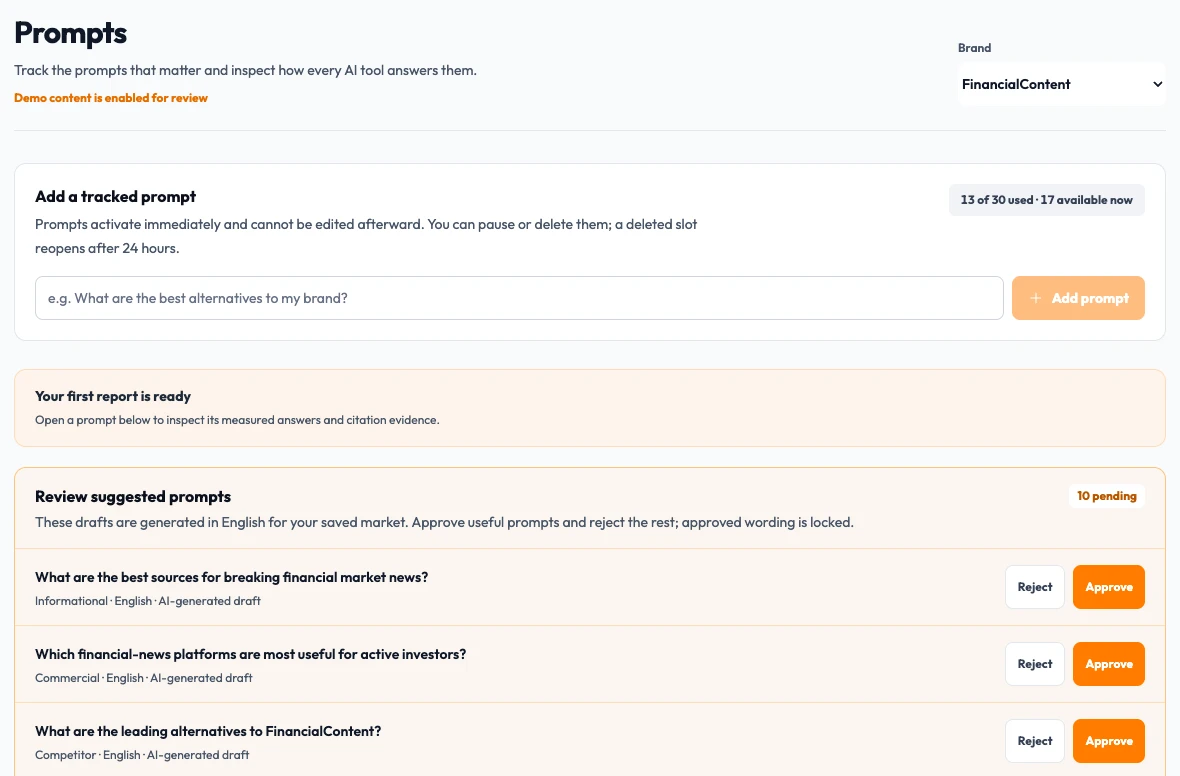
Demo data: prompt entry and suggested prompts awaiting approval.
For example, a project management product could test these buyer questions:
- Category prompts: “What tools help a small team manage projects?”
- Comparison prompts: “Is Trello or Asana easier for a five-person agency?”
- Alternative prompts: “What are alternatives to Trello for managing client projects?”
- Problem prompts: “How can an agency track client approvals across multiple projects?”
- Fit prompts: “Which project management tools work well for a five-person agency?”
You do not need to turn every possible query into a separate page. Use a small set that represents your real category and buyer questions, then inspect what the scan actually returns.
If your brand appears beside several familiar alternatives, review how each one is described and which sources support the answer.
If a competitor appears while your brand does not, treat that as a research lead. Check the prompt wording, cited pages, and product fit before you assume a content gap exists.
Keep the query and answer text with your notes so you can revisit the comparison.
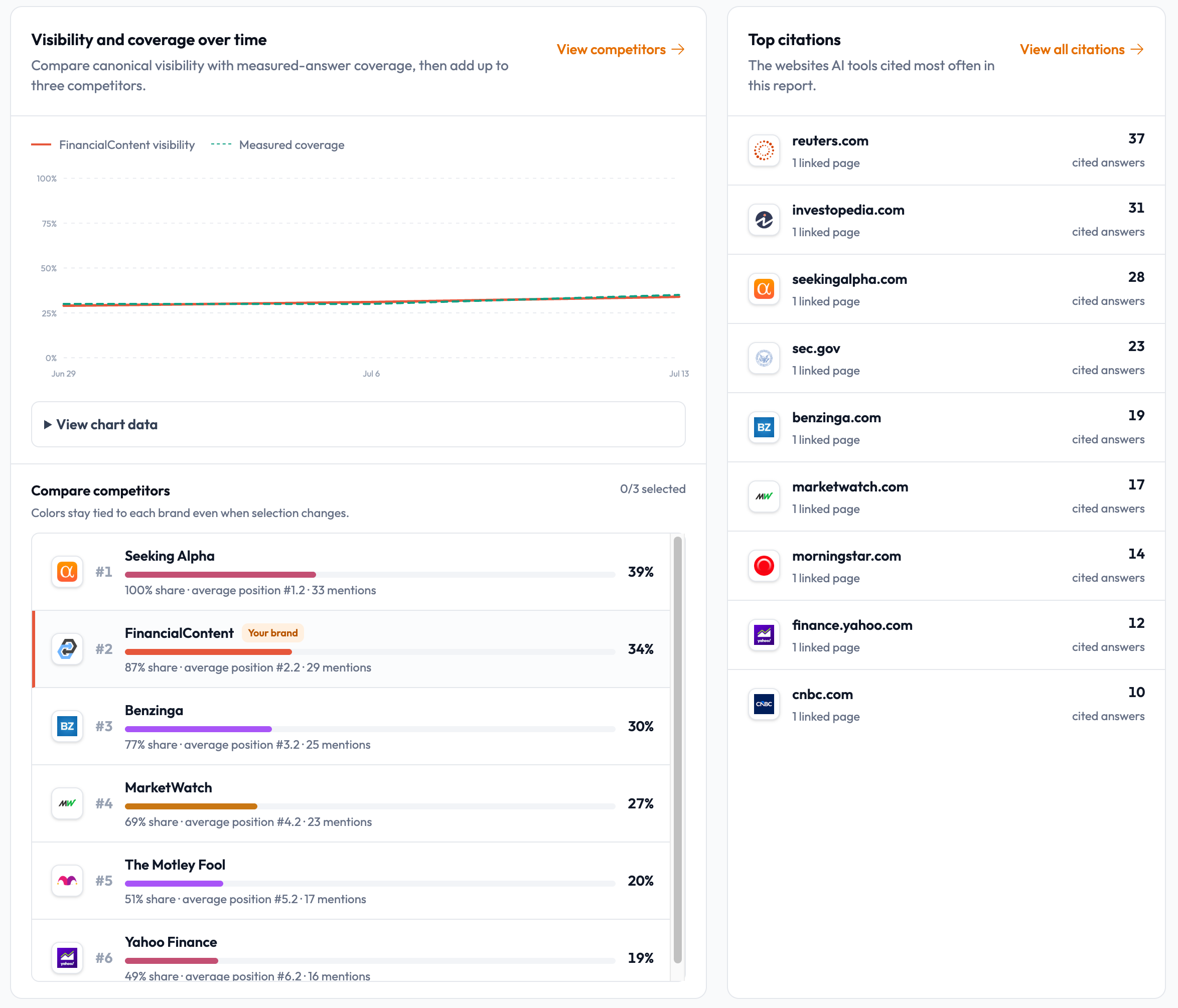
Demo data: visibility over time, competitor standings, and top cited websites.
How do you read AI citations and source gaps?
AI citations show the pages an answer presents as supporting sources, so they help you find the information layer behind a brand mention or recommendation. Compare those sources with the prompt and the answer wording.
A repeated cited domain can be a research priority, but it is not proof that the page sends traffic or controls the result.
Use the Citations view to ask four practical questions:
- Which domains recur? Separate your own site, community discussions, review sites, publishers, and competitor properties.
- Which pages recur? A single guide, comparison page, forum thread, or product page may carry more context than the domain name suggests.
- What claim does each source support? Read the page before treating the citation as an endorsement. It may support a definition, a drawback, a use case, or a comparison.
- Where is the gap? If the answer needs a source for a question you can answer accurately, decide whether the gap belongs in your site content, documentation, public discussion, or research backlog.
OpenAI’s search guidance says citations can be incomplete, outdated, or incorrect and recommends opening the source to check support.
Gemini’s help documentation also says that related sources may not appear for every response. Those limits make the source page more useful than a single visibility number.
Suppose a comparison prompt mentions your brand but cites only a review site. Read that review, verify the claim, and decide whether your product page, comparison content, or public discussion needs clearer evidence.
What should you do after a scan?
After a scan, turn repeated prompt and source patterns into a short priority list. Choose the question with the clearest business relevance, verify what the cited sources actually say, and decide which next action improves the information available to readers.
The scan guides investigation; your team chooses the next action from the evidence.
Use this review loop:
- Choose one prompt gap. Pick a question where the audience is likely comparing options and your brand is missing or described inaccurately.
- Verify the source gap. Read the cited pages and check whether they answer the question, mention a competitor, or expose an angle your own site has not covered.
- Pick the right response. Update a useful product or comparison page, publish original evidence, improve internal links, or research a relevant Reddit conversation where participation is allowed.
- Keep the claim narrow. Say what you changed and what the scan later shows. Do not claim that one page, mention, or Reddit thread caused a traffic or revenue change without separate evidence.
- Save the baseline. Keep the prompt wording, selected platform scope, date, answer excerpt, cited URLs, competitor names, and your interpretation together.
The Reddit AI search guide explains why public Reddit discussions can appear as sources and why citation rates depend on the engine, prompt set, date, and method.
The Reddit SEO strategy guide can help you research discussions that already match search demand. Use those guides to plan the work after you understand the specific gap.
Start with one scan and one useful change. If you need help turning the findings into content or a Reddit campaign, our AI SEO services cover that next step.
Frequently asked questions
What is AI search visibility?
AI search visibility is how a brand appears when an AI system answers a relevant question.
A useful check separates a brand mention, a linked citation, and the brand's prominence inside one answer. Those signals describe the measured response, not a guaranteed business outcome.
How much does Upvote.Net AI Search cost?
Upvote.Net AI Search costs $5 per scan according to the September 16, 2026 launch announcement.
Before confirming a scan, review your website, competitor URLs, and buyer questions so the report covers the comparisons you actually want to investigate.
Check the dashboard for current availability.
What is the difference between an AI mention and an AI citation?
A mention means the AI answer names your brand or product.
A citation means the answer links to a website or page as a supporting source.
A brand can be mentioned without a citation, and a cited page may not belong to the brand.
Keep mentions, citations, and answer position as separate fields.
Does AI Search guarantee citations or traffic?
No.
AI Search reports what its prompt and platform scope returned at the time of the scan.
Answers can change with the question, model, location, index, and date.
Use the result to prioritize research and content work, then measure traffic or conversions separately with the tools that own those metrics.
Which AI platforms does the current AI Search demo show?
The current product UI shows ChatGPT, Gemini, and Perplexity filters. That is the scope represented in this guide.
The available scope can change, so review the dashboard when you run a scan and record the selected platform filter with your notes.
What should I do with the sources after an AI Search scan?
Open the cited domains and pages, record what claim each source supports, and compare those findings with the prompt and answer wording.
Then choose one action: improve a useful page, publish original evidence, clarify product information, or research a relevant public discussion.
Keep the prompt, date, source URLs, and interpretation together.

Hey, I'm Sam. I've spent the last 8 years figuring out what actually works on Reddit (and what gets you instantly banned). After growing several brands through organic Reddit presence, I started Upvote to help others do the same - without the trial and error. When I'm not diving into subreddit analytics, you'll find me reading about consumer psychology or debating the best coffee brewing methods.
Related Articles

Want to amplify your Reddit results?
Explore Our Reddit Upvote Services